Rotary torque sensors for EV motor dynamometer testing
Define peak load, low-load resolution and acquisition timing together. Review a contactless shaft or bearingless flange configuration for your motor map before committing the shaft train to a drawing.
The application context is prefilled below. Add your actual duty and project details; the quoted drawing and evidence define the accepted configuration.
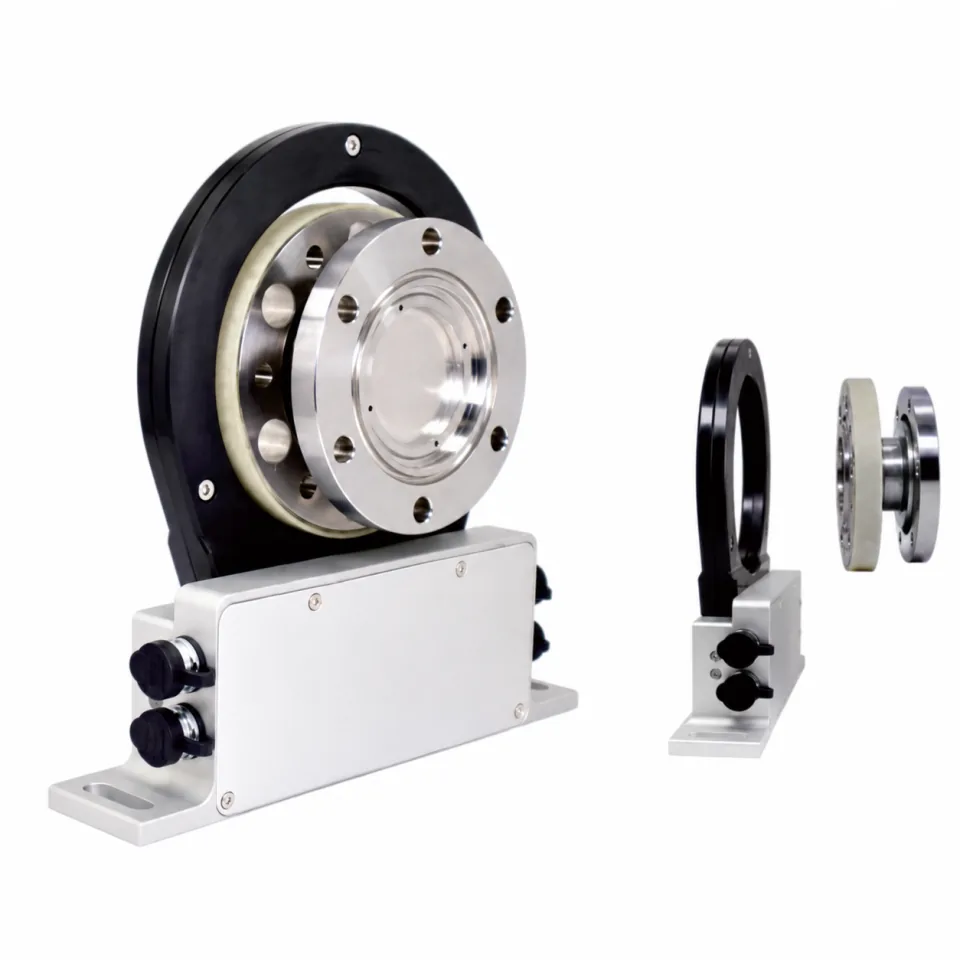
Supplier reference photograph · a family illustration, not a certified application installation.
MEASUREMENT BOUNDARY / CHANNEL ACCEPTANCE
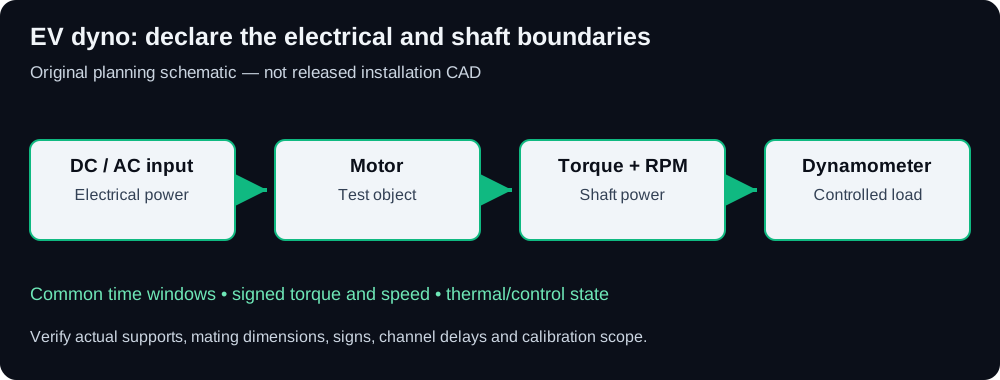
Align torque, RPM and electrical power before comparing efficiency.
Original planning diagram: DC power, AC power and motor-shaft power define different efficiency boundaries. The rotating torque measurement sits between the motor and dynamometer.
Boundary / channel
Required measurements
Result or calculation
Review before comparison
Motor shaft
Torque + signed RPM
Mechanical shaft power
Keep polarity, direction and averaging interval consistent.
Inverter AC terminals
Synchronized electrical power
Motor electrical-to-mechanical efficiency
Record the measured electrical boundary rather than a drive display estimate.
DC bus
DC voltage and current / power
Combined inverter + motor boundary
Declare auxiliary loads and regeneration direction.
Thermal and control state
Temperatures, command and time
Comparable duty points
Define stabilization and transient acceptance in the lab protocol.
These are review requirements, not released instrument ratings. Use the actual channel definitions and sign convention agreed for your laboratory.
Choose torque range, connection and signal around the duty.
High RPM needs the complete rotor/support review
Start with MT-RTR-FLG when the bearingless architecture suits the bench. Send torque at speed, pilot geometry, axial space, external support, coupling inertia and the duty cycle. Separate family maxima are not one qualified operating point.
Compare the required absolute error at the smallest working torque with every range-dependent specification term. A dual-range request must also resolve overload protection, switching versus simultaneous channels and calibration of both ranges.
Steady averages and ripple require different evidence
Define the shortest event and the desired average before selecting analog, frequency or digital output. Review sensor bandwidth, channel latency, encoder rate, DAQ filters and the mechanical response together. A fast readout alone does not validate dynamic response.
ORIGINAL HYPOTHETICAL CALCULATION / NOT MEASURED DATA
At 5 Nm, a 500 Nm full-scale term can dominate the reading.
Assume only a ±0.1% of full-scale error term. This is a sizing illustration, not a measured MT-RTR specification or a complete uncertainty statement.
Hypothetical range
Absolute term
At a 5 Nm reading
Unresolved question
500 Nm
±0.5 Nm
±10% of reading
Can low-load losses be resolved?
50 Nm
±0.05 Nm
±1% of reading
How is the low range protected from the peak?
A smaller range improves this one arithmetic term. Temperature, calibration, mounting, dynamic response and acquisition still contribute. Ask whether the actual proposal switches ranges or measures them simultaneously; verify both channels or ranges at the intended speed.
Put the test acceptance questions in the engineering request.
List continuous, peak and smallest working torque with their RPM, duration and direction; identify overspeed and emergency-stop duty for engineering review.
Mark motor and dyno shafts, support bearings, rotor pilots, coupling bores, axial float and the approved measuring-side convention.
Agree motoring/regeneration signs and common measurement windows; a near-zero input-power point needs a separate reporting rule.
Request capacity-specific drawings, actual balance/speed evidence, thermal behavior and CW/CCW calibration coverage.
Record the chosen torque output, encoder PPR/A-B behavior and all receiver/filter/latency settings before comparing maps.
EV motor dynamometers: measurement decisions before ordering.
Can one torque range cover both peak drive and small drag loss?
It may cover the physical load while missing the required low-load error. Specify both objectives and compare the complete uncertainty budget at the smallest torque. A lower range must still be protected against the actual peak.
Does torque × RPM give EV motor efficiency?
It gives mechanical shaft power. Efficiency also needs electrical power measured at a declared boundary on a consistent time basis. Motor-only and combined inverter/motor efficiency are different results.
Is the flange family maximum RPM available at every torque?
No released combination is implied by a family headline. The selected capacity, rotor geometry, support and complete shaft assembly require an approved speed/torque envelope.
Method reviewed . The diagrams, examples and worksheets are original planning aids. Actual drawings, range/speed qualification and genuine calibration/EMC reports remain configuration-specific supplier inputs.
APPLICATION-SPECIFIC MEASUREMENT BOUNDARIES
Start with the power boundary your bench must resolve.
Rotodynamic pump efficiency
Separate pump-shaft input from hydraulic output and upstream electrical losses.
Calculate shaft torque or power. Carry the duty into the RFQ.
P[kW] = T[Nm] × n[RPM] / 9549.2966. Mechanical hp uses 745.6999 W/hp; it is not metric PS. Signed inputs follow your shaft convention; capacity uses the magnitude.
The multiplier is your preliminary sizing allowance. It does not establish dynamic overload, fatigue or shaft-train safety limits. Those require the selected sensor and coupling data.
The email link carries the same entries and package options. Your email application opens a draft; send it there to deliver the request. Please share non-confidential specifications first.
Drawings, measured ratings and report availability are confirmed for the selected configuration. Please state your required delivery date and country.
Optional, for up to eight hours since your last edit. Contact details, company, country, quantity, application and original-model reference are excluded. Product pages apply their own series.
Review & download draft requirement
Save a text brief for internal engineering review before sending. Downloading does not submit the request.
Still to provide before sending: Full name; Work email; Delivery country; Target torque and units; Project quantity; Maximum operating RPM.
This file includes your entries. Share only with intended recipients.
RotaryTorqueSensor.com | Engineering requirement brief
DRAFT REQUEST — not submitted
This records requested requirements, not a quotation, released specification or calibration certificate.

Rotary torque sensor engineering request
Full name: [your name]
Work email: [your work email]
Company: [optional]
Delivery country: [country]
Series: MT-RTR-FLG
Mechanical interface: Bearingless flange
Target torque: [Nm or in-lb]
Maximum operating RPM: [RPM]
Dual-range pair: [if required]
Motor / load shafts: [diameters, fits, keys]
Signal: ±10 V
Encoder PPR: 360
Bundle: Sensor + matched coupling pair
Selected options: Integrated speed encoder: 360 / 1024 PPR (+$65 budget; 2000 PPR quoted separately) | Matched diaphragm / bellows coupling pair, custom bores (+$140 budget)
Original model / drawing: [replacement requests]
Quantity: [quantity]
Application: EV motor dynamometer: review shaft torque/RPM, motoring and regeneration, low-load/peak ranges, electrical power boundary and synchronized acquisition. Please confirm the application-specific configuration and acceptance documents.
Source page: /ev-motor-dynamometer-torque-sensors/
Please review configuration, approved drawing / STEP availability, wiring, calibration scope and quotation.

ENGINEERING REPLY CHECKLIST
- Confirm the combined torque/speed envelope, peaks and required bandwidth.
- Supply the capacity-specific approved 2D/STEP and mating-shaft review.
- Confirm connector pinout, supply, torque output and encoder/PPR.
- Identify actual calibration scope, uncertainty and report availability.
- Itemize sensor, couplings and accessories; confirm price and delivery.
- Confirm dual-range switching or simultaneous channels when requested.

Reply to [email protected] with the request reference when available.
Share this file only with intended recipients; it contains the entries you supplied.